What happens at almost every first arthodonticappointment
The parent has already done the research. They come in with a preference. Sometimes it’s aligners because they seem less noticeable. Sometimes it’s metal because it’s what someone recommended.
We listen then we look at the teeth, we have the conversation about what the teeth need.
At Little Roots Dental, this is the most important part of the orthodontic process. Not the braces. The assessment that determines which type is right for this specific child, at this specific stage of development.
Why Children Aren’t Just Small Adults in This Context
Jawbone in a growing child responds faster to orthodontic forces than adult bone. A ten-year-old who needs correction often needs less time than a thirty-year-old with the same issue.
Getting the timing or appliance wrong in a growing child doesn’t just slow progress. It can create problems. We’ve seen cases where treatment started before the second molars were through and everything had to be redone.
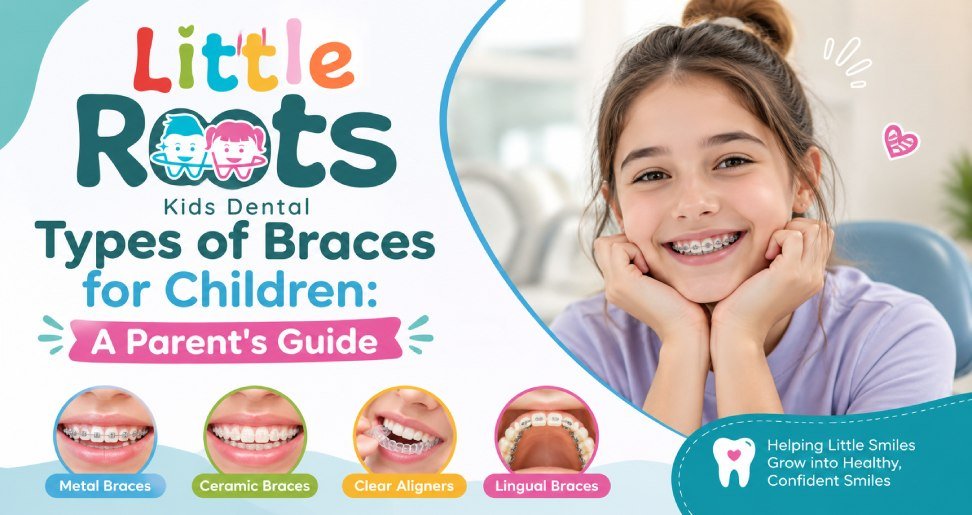
Metal Braces
Steel brackets bonded to the teeth. Wire running through them that we tighten at each appointment. The oldest type and still the most clinically reliable for complex work.
Multiple teeth rotating at once, crowding that needs extraction to create space, bite problems that need three-dimensional control. For these cases, metal is what works best. Clear aligners and ceramics don’t give us the same level of precision for significant corrections.
The appearance objection comes up constantly. We hear it. But metal braces have something that no other option has: they cannot be forgotten. They stay on the teeth. No taking out and putting back in. For a child who would leave their aligner in their sports bag for three days without noticing, metal braces remove the compliance variable entirely.
Ceramic Braces
Same mechanism as metal. Brackets and wire. The brackets are tooth-coloured instead of silver and from a normal distance they’re much less visible.
We recommend these for older children and teenagers who are bothered by the look of metal and who demonstrate good oral hygiene. Both of those conditions matter.
Ceramic brackets stain visibly within weeks of regular coffee, certain sauces, coloured sports drinks. A child who brushes after every meal gets great results. A child who doesn’t ends up with brown brackets on their front teeth. We say this before recommending ceramic, not after.
Clear Aligners
Increasingly popular. Clinically very effective for the right case. The right case is specific.
Mild to moderate alignment problems. A child who is genuinely going to wear them for 20 to 22 hours every day. That means out for meals, out for cleaning, back in within minutes of finishing. Every day for the duration of treatment.
We’ve had children in aligners come back at three-month reviews with almost no movement. The child had been leaving them out at school and putting them back in before the car ride home. Parents had no idea.
For a child who will wear them properly, aligners are excellent. Comfortable, removable for sport and instruments, easier to keep teeth clean. For a child who won’t, they’re expensive and ineffective.
Lingual Braces
Fixed to the inside surface of the teeth. Completely hidden from the front. More expensive, harder for us to adjust, and cause more tongue irritation in the first few weeks.
We use these in specific situations but they’re not the starting point for most children.
Which Type Is Actually Best for Kids?
The one that fits the clinical problem and the child’s actual personality.
We ask parents directly: is your child the type who loses their retainer monthly? Or the type who keeps their phone charger in the same place for three years? That answer changes the recommendation.
What Is Stage 4 of Braces?
Orthodontic treatment has four stages.
- Assessment.
- Active correction
- Refinement
- Retention.
Stage four is retention. Braces off, retainer in. Teeth are where they should be. Bone around them hasn’t finished hardening into the new position. The retainer holds everything still while it does.
This is the stage that undoes months of previous treatment if it’s handled badly. Retainers not worn consistently. Retainers lost and not replaced for two months. Teeth that drift back toward where they started.
We talk about stage four before treatment begins.
Before Starting: What to Sort Out
Get the full diagnostic records before agreeing to anything. X-rays, photos, study models. A plan without these is guesswork.
Ask what happens when brackets break or aligners are lost. Understand the cost before it happens.
Ask how many appointments are needed per year. A two-year treatment course with monthly visits is a real time commitment.
What Parents Ask Us
Ans :- Metal for complex problems and children who wouldn’t reliably wear a removable appliance. Ceramic for appearance-conscious older children who clean their teeth properly. Aligners for responsible children with mild to moderate issues.
Ans :- Metal, ceramic, clear aligners, and lingual. Each one suits different clinical situations. They’re not ranked. They’re different tools.
Ans :- Retention. Braces come off, retainer goes in. The teeth need holding in position while the bone finishes setting around them. Most cases of teeth shifting back happen because this stage wasn’t taken seriously.
What We’ve Noticed Over Years of Treating Children
The children who come out with the best results aren’t always the ones with the simplest cases. They’re the ones whose parents understood the process from the start and followed through on retention.
That starts with an honest assessment.
Little Roots Dental provides orthodontic assessment and all four types of braces for children. We match the treatment to the child, not the other way around. If the teeth are a concern, that assessment is the right place to begin.