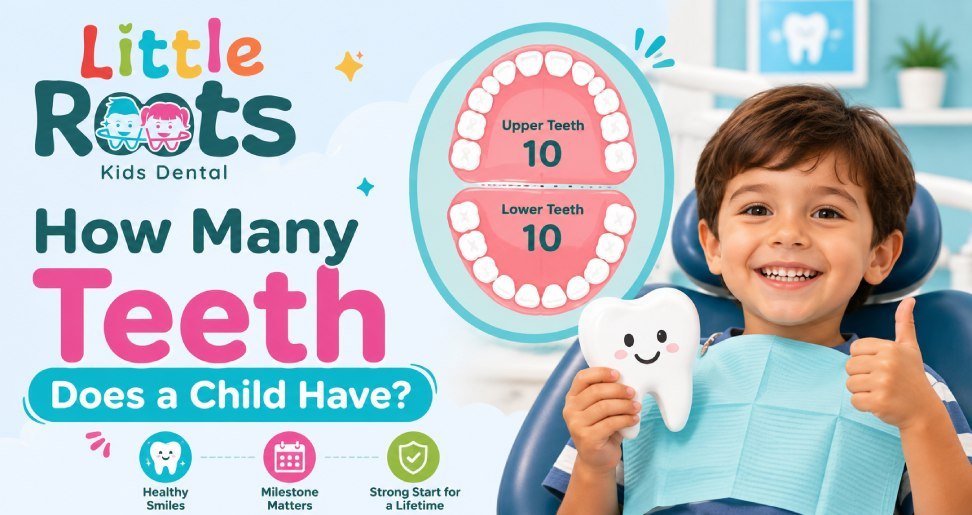
This Is the question we get asked in a hundred different ways”Should she have more teeth by now?” “He still has a gap and he’s almost three.” “My friend’s daughter had all her teeth at two and my son is two and a half and I’m not sure he’s there yet.”
Parent to parent comparisons is responsible for a significant portion of the dental worry we see at Little Roots Dental. Every child finish teething at a different point. What happened for your neighbour’s daughter is not a benchmark for your son. We say this often. It doesn’t always land.
What does help is knowing what the actual numbers look like and what range counts as normal.
Children Have Two Sets of Teeth
The first set is the baby teeth, also called primary or milk teeth. Twenty in total. Ten upper, ten lower. That’s the whole primary set not more than twenty.
The second set is the adult teeth. Thirty-two if you count wisdom teeth, which many people don’t end up keeping. Most adults have 28 visible teeth by the time everything has finished.
The handover from baby teeth to adult teeth runs from roughly age five or six all the way through to the late teens. It’s a long process and it overlaps with itself. A child can be losing baby teeth from the front while still getting baby teeth at the back. Completely normal, even though it sounds like a lot happening at once.
Can a 3-Year-Old Have 22 Teeth?
No. And we get asked this genuinely, not as a trick question.
The primary set has 20 teeth. That is the ceiling. A three-year-old cannot have 22 primary teeth because the 21st and 22nd don’t exist.
What can happen is that a three-year-old has all 20, which is perfectly normal. The last ones to come through are usually the second molars at the back. These typically arrive somewhere between age two and three, sometimes slightly after. A child who finishes their full set of 20 right around their third birthday is doing exactly what they’re supposed to be doing.
The 22-teeth count almost always comes from a parent trying to count the teeth of a child who will not hold still, with their fingers, while the child is actively trying to bite them. It’s an undercount, an overcount, or a double count. Not an extra set of teeth.
How Many Teeth Do 4 Year Olds Have?
At four, most children have all 20 primary teeth and no adult teeth yet.
This is the quiet period in dental development. The full baby set is in, nothing is supposed to be falling out yet, and the adult teeth are forming under the gum but nowhere near visible. A four-year-old with 20 teeth and no gaps from missing teeth is exactly as expected.
Some children start losing teeth earlier than five. The lower front teeth are usually first. An early first wobble at four and a half is not a problem. What we watch for is multiple teeth falling out in a short time without explanation, which can occasionally indicate something worth investigating.
Do Kids Get Any Teeth at Age 3?
Some do. The second molars, the last primary teeth to come through, often arrive between two and three. Some children are still getting them at three and a half.
Parents often assume teething is something that finishes in the first year. It doesn’t. It runs until the full primary set is through, which for some children is well past the second birthday and into the third year.
A three-year-old who is drooling more than usual, chewing on everything, or more unsettled than normal at night might still be teething. The second molars are the largest teeth in the primary set. They tend to announce themselves.
The Part That Actually Matters
Counting teeth is fine. It’s what parents think about because it’s visible and measurable. But what we pay attention to at every check-up is more than the count.
Baby teeth are not just placeholders waiting to fall out. They hold space in the jaw for the adult teeth developing underneath them. Each baby tooth sits in a gap and keeps that gap open until the adult tooth is ready to come through. When a baby tooth is lost too early, whether to decay or trauma, that space starts to close. Surrounding teeth drift. The adult tooth that arrives later finds the gap too small. It comes through crooked or crowded.
We see this at Little Roots Dental more than parents expect. A cavity in a baby tooth that seemed not worth treating because “it was going to fall out anyway” leads to crowding that takes orthodontic work to correct later.
What We Ask Parents to Do
Clean teeth as soon as they arrive. One tooth gets cleaned the same as twenty. A tiny soft brush and a rice-grain smear of fluoride toothpaste. That’s enough.
First check-up around the first birthday. Not when something looks wrong. Before it does.
If a child is past two and a half with noticeably fewer teeth than peers, mention it. Delayed eruption is sometimes a family trait and sometimes something worth an X-ray. We sort out which one quickly.
What Parents Usually Ask
Ans :- No. Twenty is the complete primary set. A three-year-old with all 20 is doing well. More than 20 isn’t possible from baby teeth.
Ans :- Usually all 20 primary teeth, no adult teeth yet. That’s the normal picture at four. Adult teeth typically don’t start coming through until five or six.
Ans :- Some do. The second molars often arrive between two and three. Some children finish the primary set closer to three and a half. Still normal.
The Number Matters Less Than the Health
A full set of 20 healthy, well-spaced baby teeth sets up the adult teeth that follow. A full set of 20 that includes cavities and poor spacing creates problems that arrive a few years later in a different form.
Little Roots Dental provides check-ups for children from the first tooth onward. If there’s a question about how many teeth a child should have or whether things are progressing normally, that check-up answers it.